Research Seminar
-
Numerical Analysis
SoSe 2025

Table of Contents
Organization [ back ]
Prof. Carsten Carstensen
Contact: Lara Théallier (lara.theallier@hu-berlin.de)
The seminar talks usually take place on Tuesday at 13 c.t..
Location [ back ]
Humboldt-Universität zu Berlin, Institut für Mathematik
Rudower Chaussee 25, 12489 Berlin
House 2, Floor 4, Room 2.417
Schedule [ back ]
| Date | Time | Talk by | Title | Room |
|---|---|---|---|---|
| 15.04.2025 | 13:15 | Carsten Carstensen (HU Berlin) |
Least-Squares Finite Element Methods | 2.417 |
| 16.04.2025 | 13:15 | Tien Tran Ngoc (Uni Augsburg) |
A simple parameter-free discontinuous Galerkin method for the diffusion problem | 2.417 |
| 22.04.2025 | 13:15 | Lina ZHAO (City University of Hong Kong) |
A novel multipoint stress control volume method for linear elasticity on quadrilateral grids | 2.417 |
| 29.04.2025 | 13:15 | Carsten Carstensen (HU Berlin) |
Computation of plates | 2.417 |
| 13.05.2025 | 13:15 | Georgi Mitzov (HU Berlin) |
Interface Problems | 2.417 |
| 20.05.2025 | 13:15 | Tim Stiebert (HU Berlin) |
Guaranteed lower and upper eigenvalue bounds for the Schrödinger eigenvalue problem | 2.417 |
| 23.05.2025 | 10:00 | Stefan Sauter (Uni Zürich) |
Numerical Solution of Interference Problems | 2.417 |
| 27.05.2025 | 13:15 | Carsten Carstensen (HU Berlin) |
Young Persons Guide to Macro Element Methodologies: from local to global infsup conditions | 1.114 |
| 17.06.2025 | 13:15 | Lukas Gehring (Uni Jena) |
Weighted Aleksandrov Estimates | 2.417 |
| 24.06.2025 | 13:15 | Emilie Pirch (Uni Jena) |
Recent results for the Monge-Ampère equation | 2.417 |
| 25.06.2025 | 13:15 | Konstantin Viol (HU Berlin) |
Implementation of the LSFEM for Indefinite Second Order PDE | 2.417 |
| 01.07.2025 | 13:15 | Johannes Storn (Uni Leipzig) |
A Quasi-Optimal Space-Time FEM With Local Mesh Refinements For Parabolic Problems | 2.417 |
| 02.07.2025 | Berlin-Beijing Numerical Analysis Half day | 2.417 | ||
| 15:00 | Lara Théallier (HU Berlin) |
Lower energy bounds for the Landau-deGennes model | ||
| 15:30 | Yi Liu (Tsinghua University) |
Introduction to a new class of BDF schemes | ||
| 16:00 | Chunmei Su (Tsinghua University) |
Low-regularity exponential integrators for the "good" Boussinesq equation with rough solutions | ||
| 03.07.2025 | 14:15 | Joscha Gedicke (Uni Bonn) |
Residual-based a posteriori error analysis for symmetric mixed FEM in elasticity | 2.420 |
| 08.07.2025 | 13:15 | Julia Schaeffer (HU Berlin) |
Contour integration methods for nonlinear eigenvalue problems in nanooptics | 2.417 |
| 16.09.2025 | 11:15 | Norbert Heuer (PUC Chile) |
Tensor finite elements for liquid crystals | 2.417 |
Abstracts [ back ]
| Speaker: | Carsten Carstensen (HU Berlin) |
|---|---|
| Title: | Computation of plates |
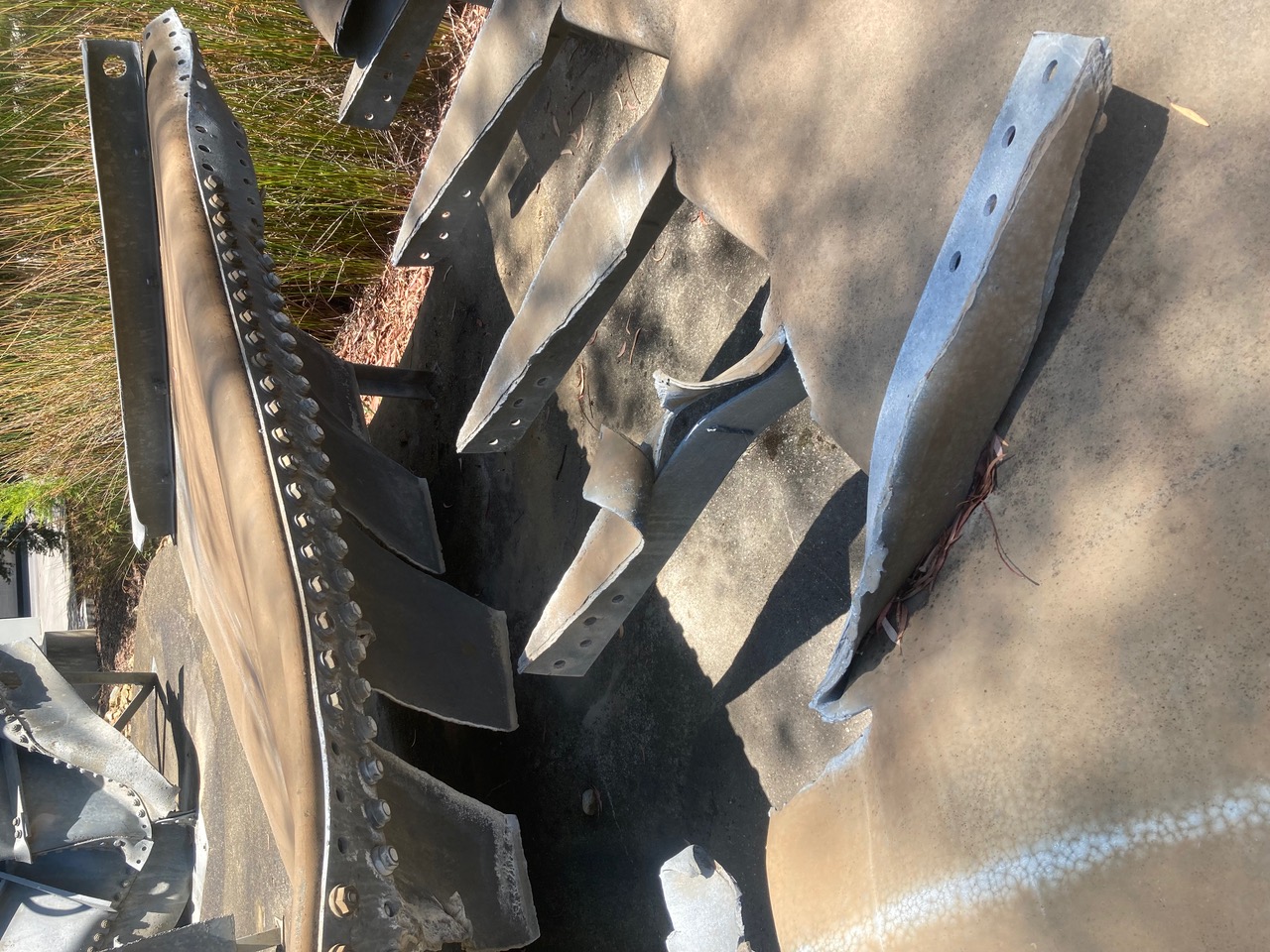
Bend plate from Monash Campus
|
The talk concerns a larger class of popular (piecewise) quadratic schemes for the fourth-order plate bending problems based on triangles are the nonconforming Morley finite element, two discontinuous Galerkin, the C0 interior penalty, and the WOPSIP schemes. The first part of the presentation discusses recent applications to the linear bi-Laplacian and to semi-linear fourth-order problems like the stream function vorticity formulation of incompressible 2D Navier-Stokes problem and the von Kármán plate bending problem. The role of a smoother is emphasised and reliable and efficient a posteriori error estimators give rise to adaptive mesh-refining strategies that recover optimal rates in numerical experiments. The last part addresses recent developments on adaptive multilevel Argyris finite element methods. The presentation is based on joint work with B. Gräßle (University of Zurich) and N. Nataraj (IITB in Mumbai) partly reflected in the references below. The eye-catcher is a photo from the Monash campus and illustrates that the plate simulation may fail because of interactions with other loadings and related to simulations in [8]. |
|
REFERENCES [1] C. Carstensen, B. Gräßle, and N. Nataraj. Unifying a posteriori error analysis of five piecewise quadratic discretisations for the biharmonic equation, J. Numer. Math., volume 32, pp. 77–109, 2024, arXiv:2310.05648. [2] C. Carstensen, B. Gräßle, and N. Nataraj. A posteriori error control for fourth-order semilinear problems with quadratic nonlinearity, SIAM J. Numer. Anal., volume 62, pp. 919–945, 2024.[3] C. Carstensen, Jun Hu. Hierarchical Argyris finite element method for adaptive and multigrid algorithms, Comput. Methods Appl. Math., volume 21, pp. 529–556, 2021. [4] C. Carstensen, N. Nataraj. A Priori and a Posteriori Error Analysis of the Crouzeix–Raviart and Morley FEM with Original and Modified Right-Hand Sides, Comput. Methods Appl. Math., volume 21, pp. 289–315, 2021.[5] C. Carstensen, N. Nataraj, G.C. Remesan, D. Shylaja. Lowest-order FEM for fourth-order semi-linear problems with trilinear nonlinearity, Numerische Mathematik 154, pp. 323–368, 2023. [6] C. Carstensen, N. Nataraj. Lowest-order equivalent nonstandard finite element methods for biharmonic plates, ESAIM: Mathematical Modelling and Numerical Analysis, 56(1), 41–78, 2022.[7] B. Gräßle. Optimal multilevel adaptive FEM for the Argyris element, Computer Methods in Applied Mechanics and Engineering, volume 399, pp. 115352, 2022. [8] C. Carstensen and D. Gallistl, Guaranteed lower eigenvalue bounds for the biharmonic equation, Numer. Math. 126 (2014), 33–51. |
|
| Speaker: | Lina ZHAO (City University of Hong Kong) |
| Title: | A novel multipoint stress control volume method for linear elasticity on quadrilateral grids |
| In this talk, I will present a novel control volume method that is locally conservative and locking-free for linear elasticity problem on quadrilateral grids. The symmetry of stress is weakly imposed through the introduction of a Lagrange multiplier. As such, the method involves three unknowns: stress, displacement and rotation. To ensure the well-posedness of the scheme, a pair of carefully defined finite element spaces is used for the stress, displacement and rotation such that the inf-sup condition holds. An appealing feature of the method is that piecewise constant functions are used for the approximations of stress, displacement and rotation, which greatly simplifies the implementation. In particular, the stress space is defined delicately such that the stress bilinear form is localized around each vertex, which allows for the local elimination of the stress, resulting in a cell-centered system. The convergence analysis will be shown for the scheme. Several numerical experiments will be performed to verify the performance of the proposed scheme. | |
| Speaker: | Stefan Sauter (Uni Zürich) |
| Title: | Numerical Solution of Interference Problems |
| In our talk, we consider high-frequency acoustic transmission problems with jumping coefficients modelled by Helmholtz equations. The solution then is highly oscillatory and, in addition, may be localized in a very small vicinity of interfaces (whispering gallery modes). For the reliable numerical approximation a) the PDE is tranformed in a classical single trace integral equation on the interfaces and b) a spectral Galerkin boundary element method is employed for its solution. We show that the resulting integral equation is well posed and analyze the convergence of the boundary element method for the particular case of concentric circular interfaces. We prove a condition on the number of degrees of freedom for quasi-optimal convergence. Numerical experiments confirm the efficiency of our method and the sharpness of the theoretical estimates. This talk comprises joint work with B. Bensiali and S. Falletta. | |
| Speaker: | Lukas Gehring (Uni Jena) |
| Title: | Weighted Aleksandrov Estimates |
| We present a stronger version of the classical Aleksandrov estimate for the Monge–Amp`ere opera- tor. Instead of the Monge–Ampère measure of the whole domain, a weight function is integrated with respect to the Monge–Ampère measure and this weight function decays to the boundary – roughly speaking with a certain power of the distance to the boundary. The inequality implies a stronger Aleksandrov–Bakelman–Pucci principle for uniformly elliptic equations and an extension of the theorem about existence of solutions of the Dirichlet problem of the Monge–Amp`ere equa- tion. Additionally, there is a generalization for the k-Hessian measure. The results expand those in ”Weighted Aleksandrov estimates: PDE and stochastic versions” by N.V. Krylov. | |
| Speaker: | Emilie Pirch (Uni Jena) |
| Title: | Recent results for the Monge-Ampère equation |
| The Monge-Ampère equation is a fully non-linear, degenerate elliptic PDE that is in non-divergence form. Recent advances in the numerical analysis of this PDE will be the subject of this talk. One of the aims is to find an error estimator that allows adaptive computation for a regularized mixed scheme. Furthermore, difficulties that arise from the limited availability of analytical tools will be discussed. | |
| Speaker: | Johannes Storn (Uni Leipzig) |
| Title: | A Quasi-Optimal Space-Time FEM With Local Mesh Refinements For Parabolic Problems |
| Abstract: We present a space-time finite element method for the heat equation that computes quasi-optimal approximations with respect to natural norms while incorporating local mesh refinements in space-time. The discretized problem is solved with a conjugate gradient method with a (nearly) optimal preconditioner. This is joint work with Lars Diening and Rob Stevenson. | |
| Speaker: | Joscha Gedicke (Uni Bonn) |
| Title: | Residual-based a posteriori error analysis for symmetric mixed FEM in elasticity |
| Abstract: The development of mixed finite element methods for linear elasticity with strongly imposed symmetry has been a long standing problem until the beginning of this century. Surprisingly for a mixed method, nodal stress degrees of freedom are necessary in order to fulfill the strong symmetry. This interesting mixed finite element also poses some difficulties for the derivation of residual based a posteriori error estimators. In a first attempt we make use of the residual a posteriori error estimator techniques for weakly symmetric stresses introducing an auxiliary approximation of the skew-symmetric gradient via a postprocessing. The second version then makes fully use of the imposed symmetry of the stress approximations utilising integration by parts twice and a suitable decomposition into tangential-tangential and normal-normal parts, similarly to the residual a posteriori error analysis for plate problems. | |
| Speaker: | Norbert Heuer (PUC Chile) |
| Title: | Tensor finite elements for liquid crystals |
| Abstract: We present a tensor-based finite element scheme for a smectic-A liquid crystal model. The tensor unknown has the regularity of a bending-moment tensor from plate bending. It can therefore be approximated by using a basis from a mixed method for plate bending. We propose a simple Cea-type finite element projection in the linear case and prove its quasi-optimal convergence. Special emphasis is put on the formulation and treatment of appropriate boundary conditions. For the nonlinear case we present a formulation in two space dimensions and prove the existence of a solution. We propose a discretization that extends the linear case in Uzawa-fashion to the nonlinear case by an additional Poisson solver. Numerical results illustrate the performance and convergence of our schemes. | |
Archive [ back ]
- Current Seminar
- Winter Semester 2025/2026
- Summer Semester 2025
- Winter Semester 2024/2025
- Summer Semester 2024
- Winter Semester 2023/2024
- Summer Semester 2023
- Winter Semester 2022/2023
- Summer Semester 2020
- Winter Semester 2019/2020
- Summer Semester 2019
- Winter Semester 2018/2019
- Summer Semester 2018
- Winter Semester 2017/2018
- Summer Semester 2017
- Winter Semester 2016/2017
- Summer Semester 2016
- Winter Semester 2015/2016
- Summer Semester 2015
- Winter Semester 2014/2015
- Summer Semester 2014
- Winter Semester 2013/2014
- Summer Semester 2013
- Winter Semester 2012/2013
- Summer Semester 2012
- Winter Semester 2011/2012
- Summer Semester 2011