Research Seminar
WS 2019/20

Table of Contents
Organization [ back ]
Prof. Carsten Carstensen
Contact: Sophie Puttkammer (puttkams(at)math.hu-berlin.de)
Location [ back ]
Humboldt-Universität zu Berlin, Institut für Mathematik
Rudower Chaussee 25, 12489 Berlin
Room 2.417 or Room 3.007
Gallery [ back ]
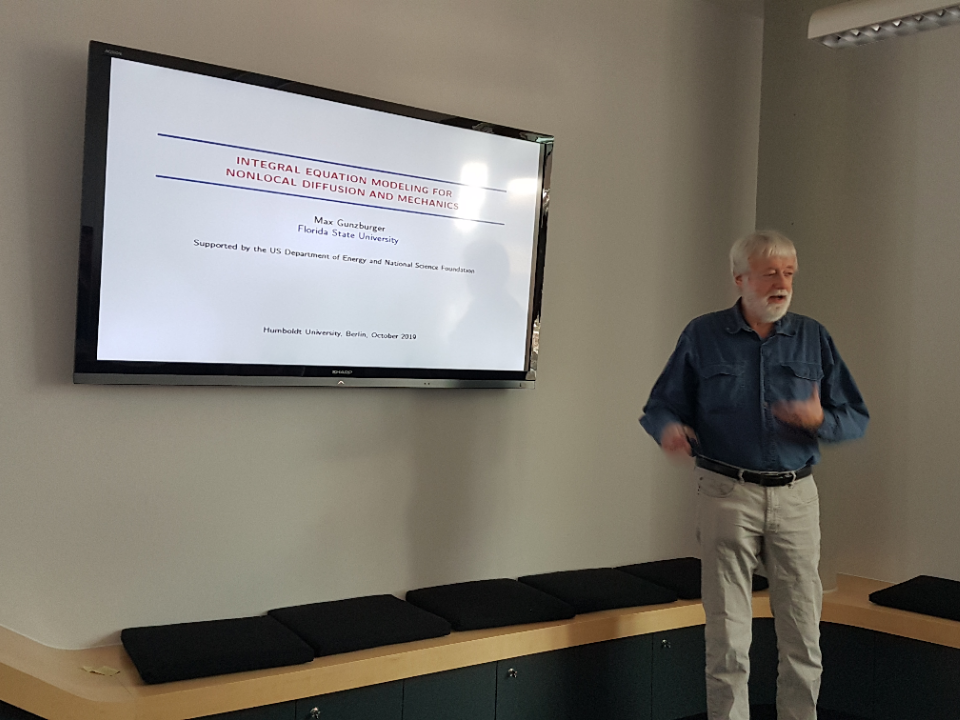
Max Gunzburger on October 31
Schedule [ back ]
| Date | Time | Talk by | Title | Room |
|---|---|---|---|---|
| October 16, 2019 | 11:15 | Georgi Mitsov (HU Berlin) |
On the well-posedness of a generalized dPG time-stepping methods for the heat equation | 3.007 |
| October 23, 2019 | 11:15 | Julian Streitberger (HU Berlin) |
Two Lowest Order MFEM Examples | 2.417 |
| October 23, 2019 | 11:45 | Sophie Puttkammer (HU Berlin) |
A modified HHO method to compute guaranteed lower eigenvalue bounds | 2.417 |
| October 29, 2019 | 11:15 | Tim Ricken (Universität Stuttgart) |
Neue Methoden zur Modellierung von Mehrphasenmaterialien mit Mehrskalenansätzen - Anwendungsbeispiele aus den Bereichen Materialwissenschaft, Biomechanik und Umwelttechnik | 2.417 |
| October 30, 2019 | 11:15 | Tien Tran-Ngoc (HU Berlin) | HHO methods for a class of degenerate convex minimization problems | 3.007 |
| October 31, 2019 | 9:30 | Max Gunzburger (Florida State University) | Integral equation modeling for anomalous diffusion and nonlocal mechanics | 2.417 |
| November 6, 2019 | 11:15 | Julia Schäffer (HU Berlin) | Convergence rates for the FEAST algorithm with dPG resolvent discretization | 2.417 |
| November 6, 2019 | 14:45 | Neela Nataraj (IIT Bombay) | Finite element methods for nematic liquid crystals | 2.417 |
| November 13, 2019 | 11:15 | Ornela Mulita (SISSA) | Smoothed Adaptive Finite Element Methods | 2.417 |
| November 20, 2019 | 11:15 | Ma Rui (HU Berlin) | Convergence of the adaptive nonconforming element method for an obstacle problem | 2.417 |
| November 27, 2019 | 15:00 | Stefan Sauter (Universität Zürich) | 𝒟ℋ2 Matrices and their Application to Scattering Problems | 2.417 |
| December 4, 2019 | 11:15 | Céline Torres (Universität Zürich) | Stability of the Helmholtz equation with highly oscillatory coefficients | 2.417 |
| December 11, 2019 | 11:15 | Benedikt Gräßle (HU Berlin) | Numerical Analysis with HHO methods | 2.417 |
| December 18, 2019 | 11:00 | Henrik Schneider (HU Berlin) | DPG for the Laplace eigenvalue problem | 2.417 |
| January 8, 2020 | 11:15 | Sophie Puttkammer (HU Berlin) | Remarks on optimal convergence rates for guaranteed lower eigenvalue bounds with a modified nonconforming method | 2.417 |
| January 10, 2020 | 13:00 | Oliver Sander (TU Dresden) | Geometric Finite Element | 3.008 |
| January 15, 2020 | 11:15 | Philipp Bringmann (HU Berlin) | Convergence proofs for adaptive LSFEMs and implementation of the octAFEM3D software package | 2.417 |
| January 22, 2020 | 11:15 | Joscha Matysiak (HU Berlin) | This presentation is rescheduled on February 12th. | |
| January 29, 2020 | 11:15 | Georgi Mitsov (HU Berlin) | Well-posedness of generalized dPG methods with locally weighted test-search norms for the heat equation | 3.007 |
| January 29, 2020 | 16:15 | Alexander Heinlein (Universität zu Köln) | Overlapping Schwarz preconditioning techniques for nonlinear problems | 2.417 |
| January 31, 2020 | 13:30 | Philipp Bringmann (HU Berlin) | Adaptive least-squares finite element method with optimal convergence rates | 2.417 |
| February 12, 2020 | 11:15 | Joscha Matysiak (HU Berlin) | TBA | TBA |
Abstracts [ back ]
| Speaker: | Max Gunzburger |
|---|---|
| Title: | Integral equation modeling for anomalous diffusion and nonlocal mechanics |
| We use the canonical examples of fractional Laplacian and peridynamics equations to discuss their use as models for nonlocal diffusion and mechanics, respectively, via integral equations with singular kernels. We then proceed to discuss theories for the analysis and numerical analysis of the models considered, relying on a nonlocal vector calculus to define weak formulations in function space settings. In particular, we discuss the recently developed asymptotically compatible families of discretization schemes. Brief forays into examples and extensions are made, including obstacle problems and wave problems. | |
| Speaker: | Neela Nataraj |
| Title: | Finite element methods for nematic liquid crystals |
|
We consider a system of second order non-linear elliptic partial differential equations that models the equilibrium configurations of a two dimensional planar bistable nematic liquid crystal device. Discontinuous Galerkin finite element methods are used to approximate the solutions of this nonlinear problem
with non-homogeneous Dirichlet boundary conditions. A discrete inf-sup condition demonstrates the stability of the discontinuous Galerkin discretization of a well-posed linear problem. We then establish the existence and local uniqueness of the discrete solution of the non-linear problem. An a priori error
estimate in the energy norm is derived and the quadratic convergence of Newton’s iterates is illustrated.
This is a joint work with Ruma Maity and Apala Majumdar. |
|
| Speaker: | Ornela Mulita |
| Title: | Smoothed Adaptive Finite Element Methods |
| We propose a new algorithm for Adaptive Finite Element Methods based on Smoothing iterations (S-AFEM). The algorithm is inspired by the ascending phase of the V-cycle multigrid method: we replace accurate algebraic solutions in intermediate cycles of the classical AFEM with the application of a prolongation step, followed by a fixed number of few smoothing steps. The method reduces the overall computational cost of AFEM by providing a fast procedure for the construction of a quasi-optimal mesh sequence with large algebraic error in the intermediate cycles. Indeed, even though the intermediate solutions are far from the exact algebraic solutions, we show that their a-posteriori error estimation produces a refinement pattern that is substantially equivalent to the one that would be generated by classical AFEM, at a considerable fraction of the computational cost. In this talk, we will quantify rigorously how the error propagates throughout the algorithm, and then we will provide a connection with classical a posteriori error analysis. Finally, we will present a series of numerical experiments that highlights the efficiency and the computational speedup of S-AFEM. | |
| Speaker: | Stefan Sauter |
| Title: | 𝒟ℋ2 Matrices and their Application to Scattering Problems |
|
The sparse approximation of high-frequency Helmholtz-type integral operators has many important physical applications such as problems in wave propagation and wave scattering. The discrete system matrices are huge and densely populated; hence their sparse approximation is of outstanding importance. In our talk we will generalize the directional ℋ2
-matrix techniques from the "pure" Helmholtz operator
with
real, to general complex frequencies
with .
In this case, the fundamental solution decreases exponentially for large arguments. We will develop a new admissibility condition which contain
and in an explicit way and introduce the approximation of the integral kernel function on admissible blocks in terms of frequency-dependent directional expansion functions. We present an error analysis which is explicit with respect to the expansion order and with respect to the real and imaginary part of . This allows us to choose the variable expansion order in a quasi-optimal way depending on but independent of, possibly large, . The complexity analysis is explicit with respect to and and shows how higher values of reduce the complexity. In certain cases, it even turns out that the discrete matrix can be replaced by its nearfield part.
Numerical experiments illustrate the sharpness of the derived estimates and the efficiency of our sparse approximation. This talk comprises joint work with S. Börm, Christian-Albrechts-Universität Kiel, Germany and M. Lopez-Fernandez, Sapienza Universita di Roma, Italy. |
|
| Speaker: | Céline Torres |
| Title: | Stability of the Helmholtz equation with highly oscillatory coefficients |
| Existence and uniqueness of the heterogeneous Helmholtz problem on bounded domains can be shown using a unique continuation principle in Fredholm's alternative. This results in an energy estimate of the problem, with a stability constant that is not directly explicit in the coefficients or the wave number. We show, that for highly oscillatory coefficients, the solution can exhibit a localised wave. As a result the stability grows exponentially in the wave number. We discuss how this constant enters in the condition for quasi-optimality, when using a hp-Finite Element Method to discretise the problem and the difficulties that arise therein. | |
Archive [ back ]
- Current Seminar
- Winter Semester 2025/2026
- Summer Semester 2025
- Winter Semester 2024/2025
- Summer Semester 2024
- Winter Semester 2023/2024
- Summer Semester 2023
- Winter Semester 2022/2023
- Summer Semester 2020
- Winter Semester 2019/2020
- Summer Semester 2019
- Winter Semester 2018/2019
- Summer Semester 2018
- Winter Semester 2017/2018
- Summer Semester 2017
- Winter Semester 2016/2017
- Summer Semester 2016
- Winter Semester 2015/2016
- Summer Semester 2015
- Winter Semester 2014/2015
- Summer Semester 2014
- Winter Semester 2013/2014
- Summer Semester 2013
- Winter Semester 2012/2013
- Summer Semester 2012
- Winter Semester 2011/2012
- Summer Semester 2011