Research Seminar
WS 2017/18

Table of Contents
Organisation [ back ]
Prof. Carsten Carstensen
Contact: Friederike Hellwig (hellwigf@math.hu-berlin.de)
Location [ back ]
Humboldt-Universität zu Berlin, Institut für Mathematik
Rudower Chaussee 25, 12489 Berlin
Room 2.417
Gallery [ back ]

Carsten Carstensen on November 2
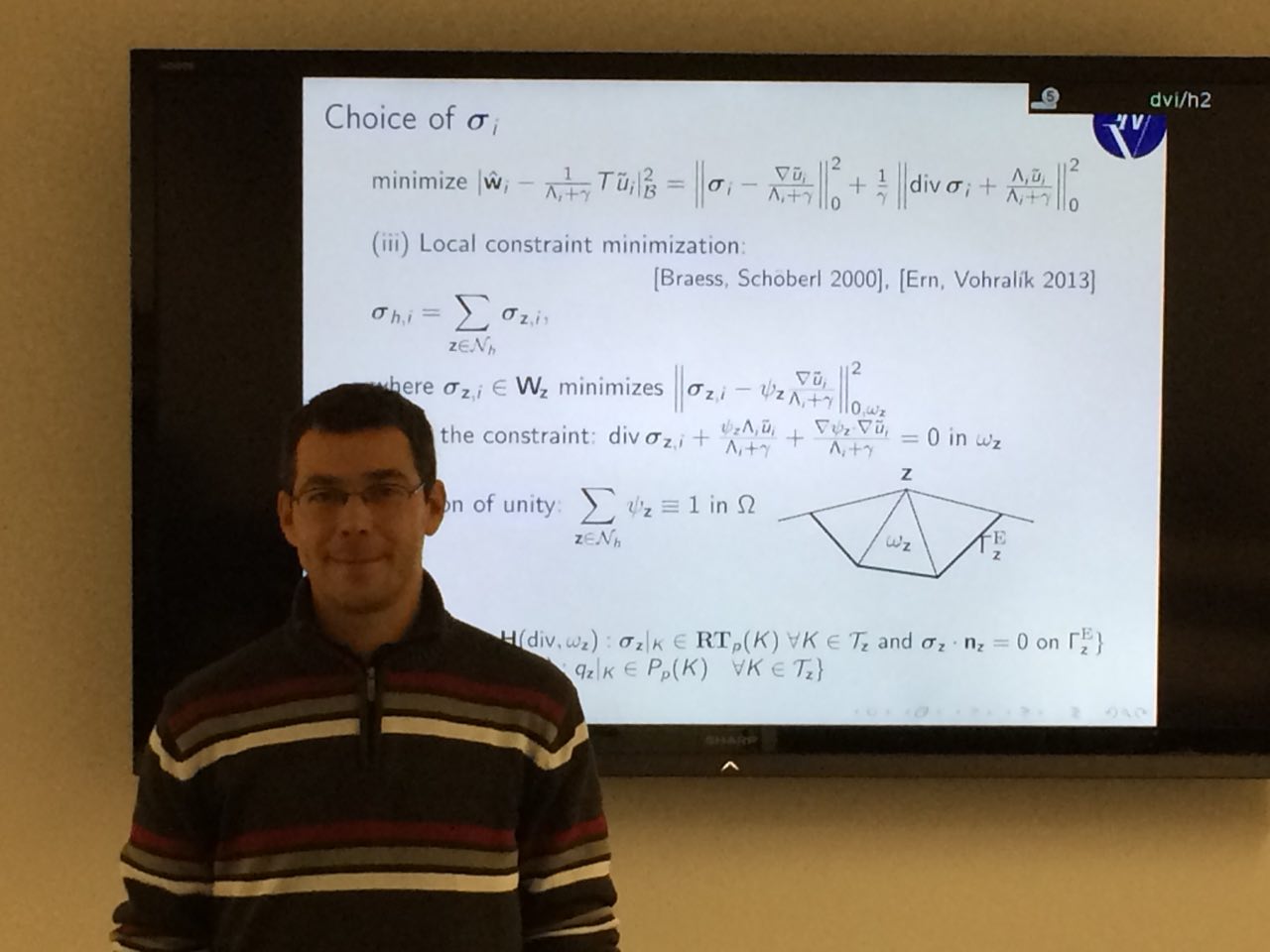
Tomáš Vejchodský on November 16
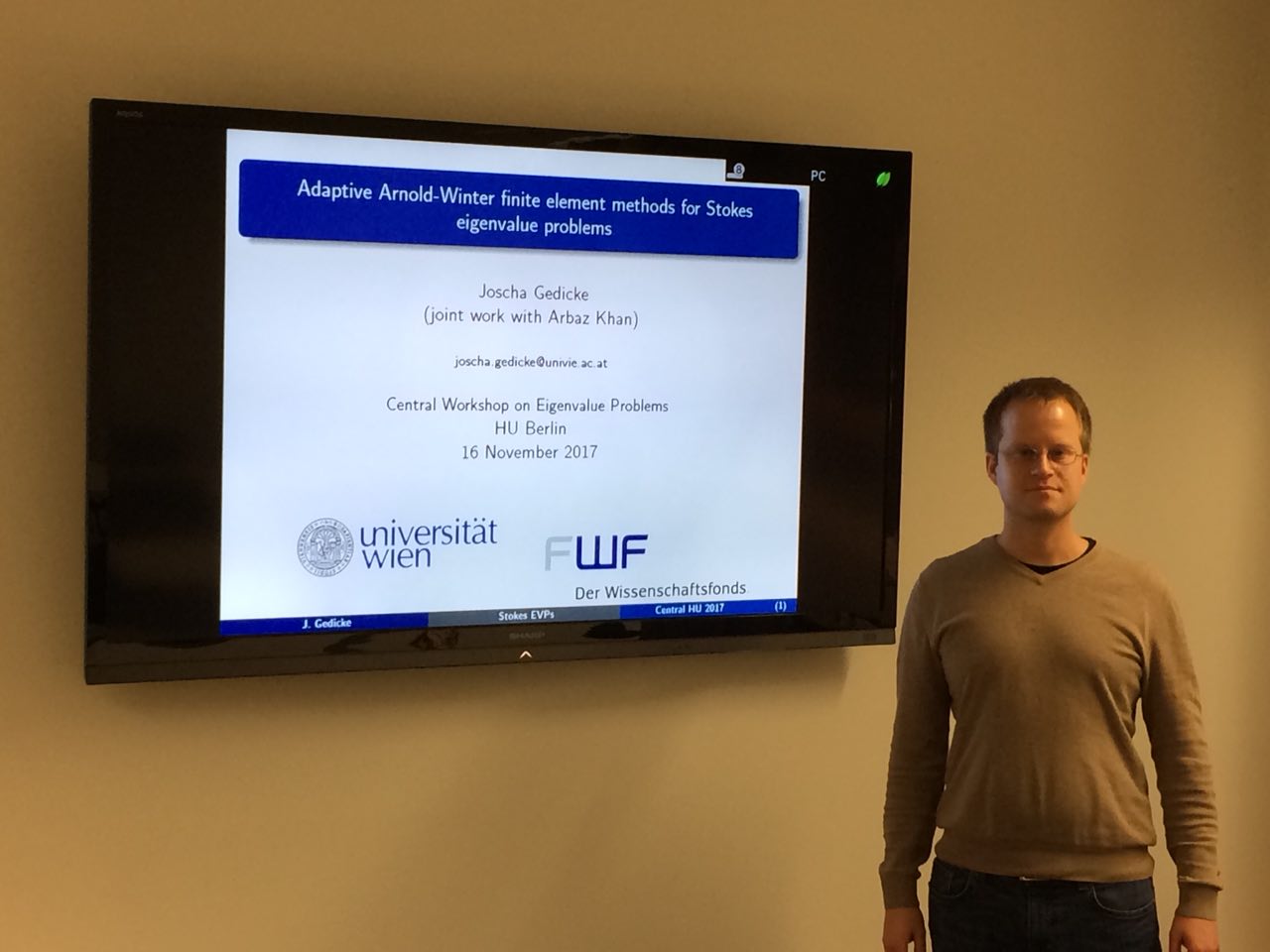
Joscha Gedicke on November 16
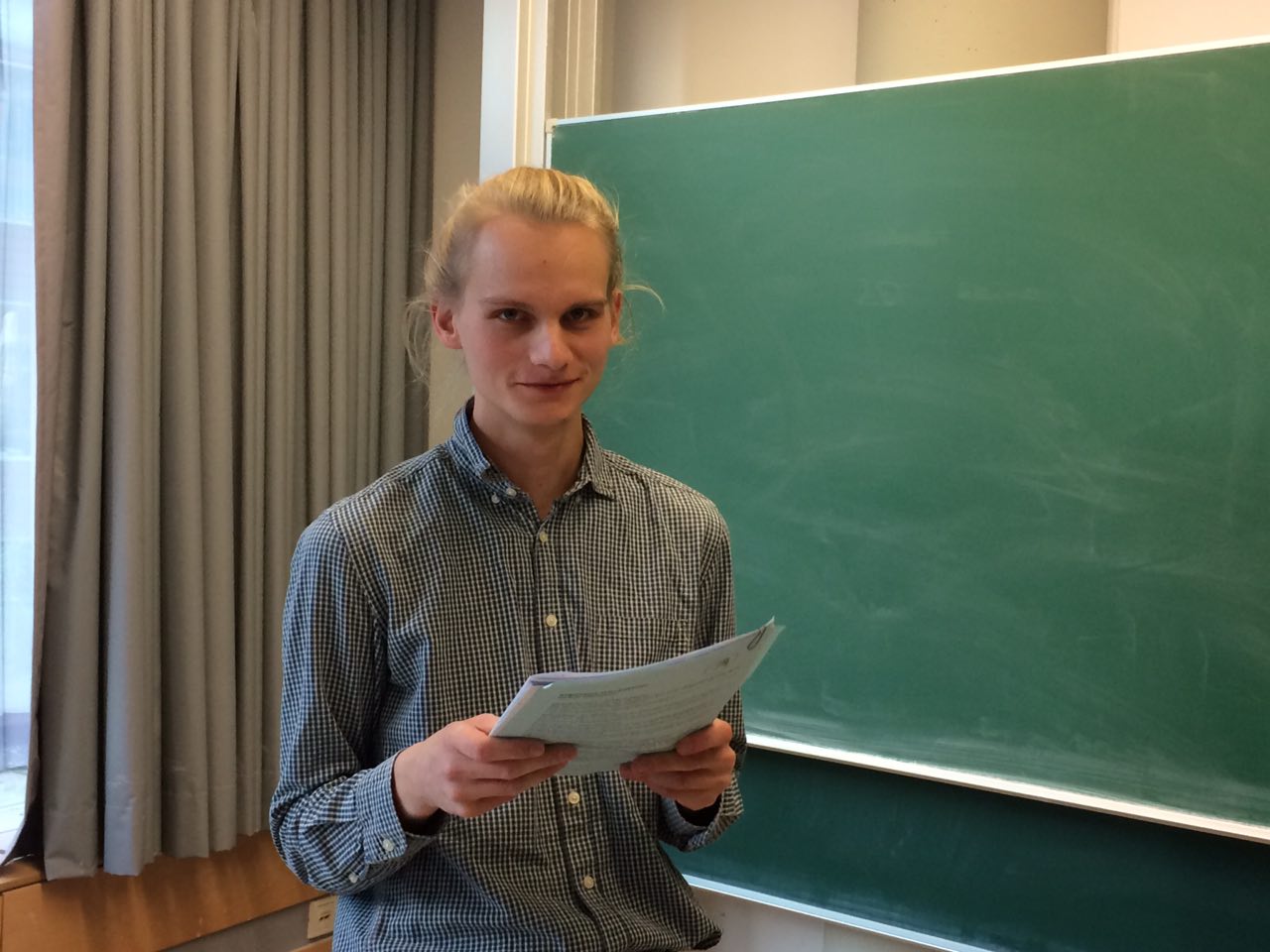
Lukas Gehring on December 7
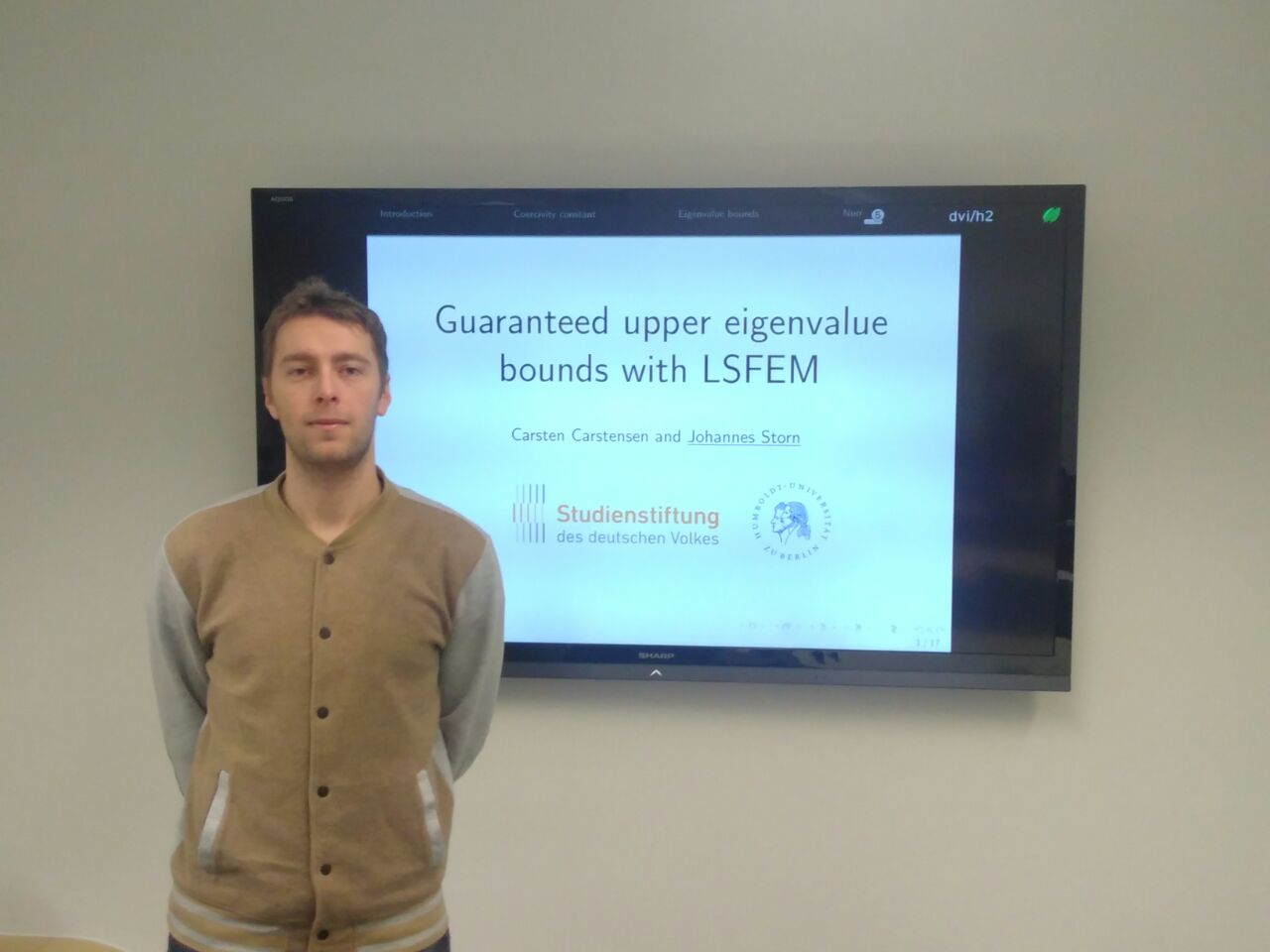
Johannes Storn on January 11
Schedule [ back ]
| Date | Time | Talk by | Title |
|---|---|---|---|
| October 19, 2017 | 09:15 | Johannes Storn (HU Berlin) |
Asymptotic Exactness of the dPG Method |
| October 26, 2017 | 09:15 | Nando Farchmin (HU Berlin) |
A Discontinuous Petrov-Galerkin Finite Element Method for a Model Problem in Topology Optimization |
| November 2, 2017 | 09:15 | Carsten Carstensen (HU Berlin) |
Optimal Convergence Rates for Adaptive Lowest Order Discontinuous Petrov-Galerkin Method |
| November 2, 2017 | 14:00 | Carsten Carstensen (HU Berlin) |
Optimal Convergence Rates for a Least-Squares Method |
| November 9, 2017 | 09:15 | Stephan Schwöbel (HU Berlin) |
Über den Zusammenhang zwischen 4 dPG-FEM und gewichteten LS-FEM |
| November 16, 2017 | 14:30 | Tomáš Vejchodský (The Czech Academy of Sciences, Prague) |
Flux reconstructions and lower bounds on eigenvalues |
| November 16, 2017 | 15:00 | Joscha Gedicke (Universität Wien) |
Adaptive Arnold-Winter finite element methods for Stokes eigenvalue problems |
| November 23, 2017 | 09:15 | Zaven Badalyan (HU Berlin) |
Eine primale dPG Methode für nichtlineare Elastizität |
| November 30, 2017 | 09:15 | Tran Ngoc Tien (HU Berlin) |
CR = dRT in convex minimisation problem |
| December 7, 2017 | 09:15 | Lukas Gehring (HU Berlin) |
Adaptive Verfeinerung in n Dimensionen, binäre Wälder (Teil I) |
| December 14, 2017 | 09:15 | Lukas Gehring (HU Berlin) |
Adaptive Verfeinerung in n Dimensionen, binäre Wälder (Teil II) |
| December 21, 2017 | 09:15 | Lukas Gehring (HU Berlin) |
Adaptive Verfeinerung in n Dimensionen, binäre Wälder (Teil III) |
| January 11, 2018 | 09:15 | Johannes Storn (HU Berlin) |
Guaranteed upper eigenvalue bounds with LSFEM |
| January 18, 2018 | 09:15 |
Philipp Bringmann (HU Berlin) |
On the approximation of Dirichlet boundary conditions in R³ |
| January 22, 2018 | 11:00 |
Fleurianne Bertrand (Universität Duisburg-Essen) |
|
| January 24, 2018 | 09:15 |
Dietmar Gallistl (Karlsruher Institut für Technologie) |
A robust discretization of the Reissner-Mindlin plate with arbitrary polynomial degree |
| February 1, 2018 | 09:15 |
Sophie Puttkammer (HU Berlin) |
|
| February 6, 2018 | 15:15 | Studierende des Projektpraktikums II | |
| February 15, 2018 | 09:15 | Stephan Daniel Schwöbel (HU Berlin) |
Über den Zusammenhang von 4 dPG-FEM mit gewichteten LS-FEM |
Abstracts [ back ]
| Speaker: | Tomáš Vejchodský |
|---|---|
| Title: | Flux reconstructions and lower bounds on eigenvalues |
| Computing lower bounds on eigenvalues of symmetric elliptic second-order partial differential operators is a challenging problem. It has been studied for many decades and among the variety of approaches the Lehmann-Goerisch method is one of the most successful. The Lehmann-Goerisch method is based on conforming approximations of eigenfunctions, certain a priori known (and perhaps rough) lower bound on some eigenvalue and a flux reconstruction, which is traditionally computed by solving a large saddle point problem by mixed finite element problem. The talk will review the Lehmann-Goerisch method and show that rather than solving the large mixed finite element problem, we can straightforwardly utilize modern flux reconstruction techniques known from the source problems. This flux reconstruction can be computed locally and in parallel by solving a sequence of small independent problems. It enables to use finer meshes and achieve higher accuracy than the traditional approach. | |
| Speaker: | Joscha Gedicke |
| Title: | Adaptive Arnold-Winter finite element methods for Stokes eigenvalue problems |
| Over the last decade, the a posteriori error analysis of eigenvalue problems using finite element approximations has been well developed. However, most results are for the Laplace eigenvalue problem and only a few papers consider the a posteriori error analysis for the Stokes eigenvalue problem. In this talk we present the a priori and a posteriori error analysis for the Stokes eigenvalue problem based on higher order finite elements which enables high order approximations of Stokes eigenvalues. We study the Arnold-Winter mixed finite element formulation for the two-dimensional Stokes eigenvalue problem using the stress-velocity formulation. We present a priori error estimates for eigenvalues and eigenfunctions. To improve the approximation of the eigenvalues, we derive a local postprocessing. For smooth data we prove higher order convergence of the postprocessed eigenvalues. With the help of the higher order local postprocessing, we develop a reliable a posteriori error estimator for the eigenvalue error. We discuss several numerical examples to validate the theoretical higher order convergence of the postprocessing and the reliability and empirical efficiency of the derived a posteriori error estimator. This is joint work with Arbaz Khan. | |
| Speaker: | Dietmar Gallistl |
| Title: | A robust discretization of the Reissner-Mindlin plate with arbitrary polynomial degree (joint work with M. Schedensack) |
| The transverse displacement w of a thin elastic plate of thickness t>0 and the rotation φ of the plate's fibers normal to the mid-surface can be described by the Reissner--Mindlin plate model. Standard schemes are known to exhibit shear locking and yield poor results for small thickness t << h. It was the observation of Brezzi and Fortin (1986) that the Helmholtz decomposition of the shear variable ζ := t-2 (∇ w - φ) may serve as the key for the robust numerical approximation of this problem. Arnold and Falk (1989) discovered a discrete analogue to that decomposition which led to a robust nonconforming finite element discretization. Their discrete Helmholtz decomposition turned out useful for other purposes, too; but in its original form it is restricted to piecewise affine finite element functions and so to the lowest-order case. This talk proposes a new numerical scheme for the Reissner--Mindlin plate model. The method is based on a discrete Helmholtz decomposition and can be viewed as a generalization of the nonconforming finite element scheme of Arnold and Falk. The two unknowns in the discrete formulation are the in-plane rotations and the gradient of the vertical displacement. In the stability and error analysis, the decomposition of the discrete shear variable leads to equivalence with the usual Stokes system with penalty term plus two Poisson equations and the proposed method is equivalent to a stabilized discretization of the Stokes system that generalizes the Mini element. The method is proved to satisfy a best-approximation result which is robust with respect to the thickness parameter t. | |
Archive [ back ]
- Current Seminar
- Winter Semester 2025/2026
- Summer Semester 2025
- Winter Semester 2024/2025
- Summer Semester 2024
- Winter Semester 2023/2024
- Summer Semester 2023
- Winter Semester 2022/2023
- Summer Semester 2020
- Winter Semester 2019/2020
- Summer Semester 2019
- Winter Semester 2018/2019
- Summer Semester 2018
- Winter Semester 2017/2018
- Summer Semester 2017
- Winter Semester 2016/2017
- Summer Semester 2016
- Winter Semester 2015/2016
- Summer Semester 2015
- Winter Semester 2014/2015
- Summer Semester 2014
- Winter Semester 2013/2014
- Summer Semester 2013
- Winter Semester 2012/2013
- Summer Semester 2012
- Winter Semester 2011/2012
- Summer Semester 2011